Pump.Fun Sniper Bot: Bonding Curve Math, Graduations, and Solana Execution
Pump.Fun looks simple from the outside — anyone can launch a token in seconds — but the platform is actually a deterministic bonding-curve AMM with a hard graduation threshold to Raydium. Understanding that math is the difference between sniping launches that 10x and sniping launches that immediately rug. This guide focuses on the bonding curve mechanics, the graduation event, and how the Vexor Snipe Engine executes Pump.Fun trades on Solana via Jupiter V6 and Alchemy rather than a third-party widget. Vexor's Pump.fun sniper bot is the same Snipe Engine tuned for these bonding-curve mechanics.
The Pump.Fun bonding curve, explained as a price function
Every Pump.Fun token launches with a fixed virtual reserve curve: roughly 1.073B tokens against 30 SOL of virtual SOL reserves, priced as a constant-product AMM (`x * y = k`). Three things follow from that:
- The first buyers always get the steepest discount — price impact compounds quickly as virtual SOL reserves fill.
- Graduation to Raydium triggers when ~85 SOL of real reserves accumulate (the curve sells ~793M tokens by then). At that moment, liquidity migrates to a real Raydium pool, the curve closes, and the price discovery model changes entirely.
- The bonding curve cannot be rugged in the classic sense — the LP is algorithmic — but the deployer can still dump their pre-curve allocation, and post-graduation Raydium pools can absolutely be rugged unless LP is burned.
A real Pump.Fun sniper has to price three different regimes: pre-graduation curve, the graduation transition itself, and the post-Raydium pool. Most generic "sniper bot" UIs treat them as one thing, which is why their fills are bad.
What actually decides whether a launch is snipeable
Forget meme aesthetics. The on-chain signals that correlate with a launch worth sniping are concrete:
- Deployer wallet history. Repeat deployers with prior graduations are statistically very different from one-off wallets funded 10 minutes before launch.
- Initial holder concentration in the first 30 seconds. If the top 5 wallets capture more than ~25% of supply within the first slots, the dump risk during the curve is severe.
- Curve velocity. Real interest shows up as steady bonding-curve progression, not one giant buy followed by silence. Velocity drop-offs predict failed graduations.
- Social signal alignment. Twitter / Telegram volume must lead price, not lag it. Lagging social is almost always a rug-in-progress.
None of this is visible from the Pump.Fun UI alone — it requires a discovery layer that reads Solana state in real time.
Vexor's Solana discovery and execution stack
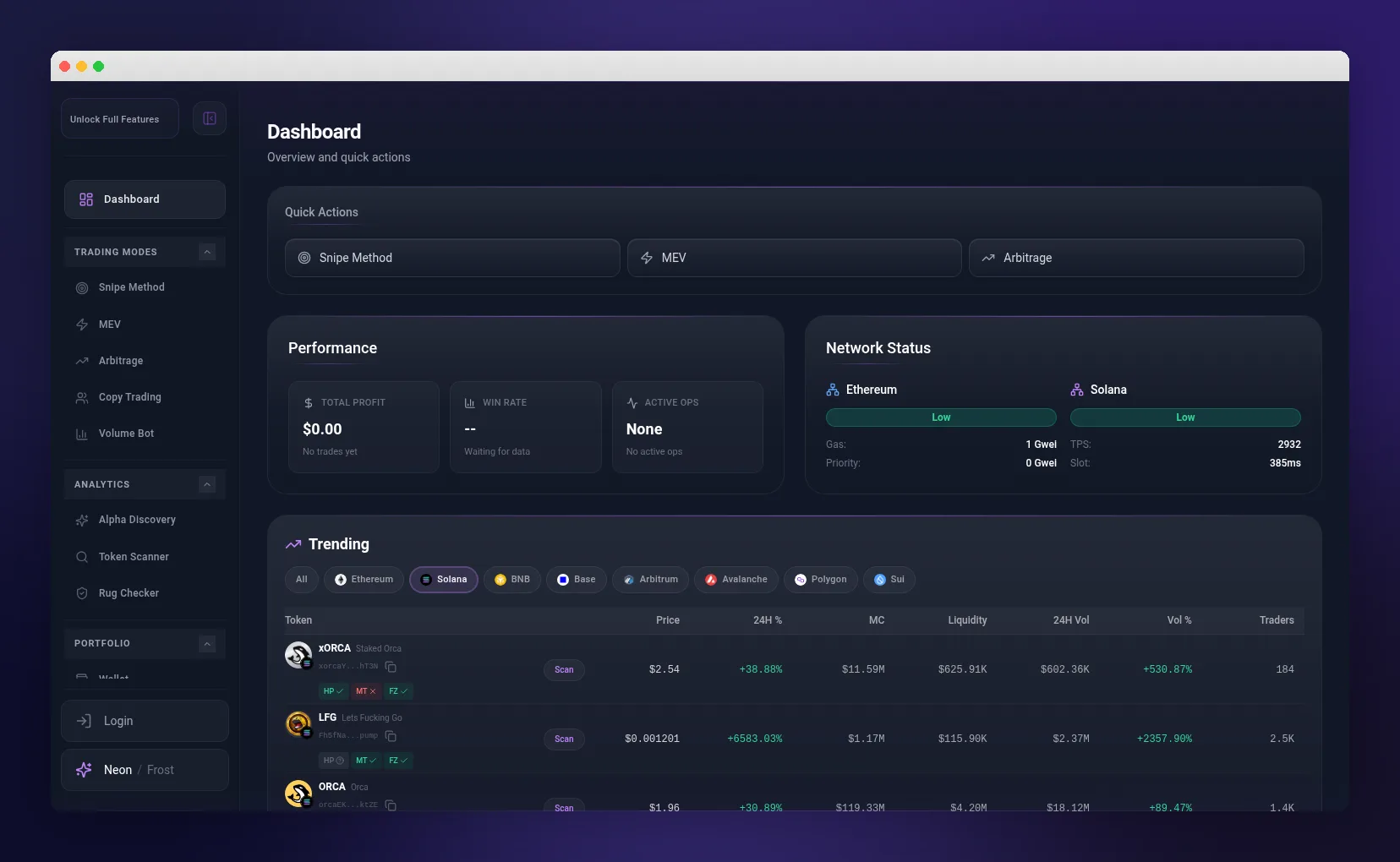
Vexor's Snipe Method on Solana is wired directly into the same infrastructure that powers the rest of the platform: Jupiter V6 for routing, Alchemy for RPC and WebSocket subscriptions, and the Vexor AI Risk Engine for the safety gate. The trending and discovery surface (Birdeye-backed, with on-chain backfill) is where Pump.Fun candidates first appear.
What the engine actually does for a Pump.Fun trade:
- Discovery. New Solana tokens (including Pump.Fun deployments) flow into the Trending widget with a 12-hour TTL cache and progressive safety backfill, so by the time you see a candidate it already has Trust Score, holder distribution, and LP status attached.
- Pre-trade gating. The Vexor AI Risk Engine assigns a 1–10 Safety Score per token, with serial-rugger checks via the Vexor AI Risk Engine and a Token Scanner pass. Pump.Fun launches with hostile deployer history or honeypot patterns are blocked before the buy instruction is constructed.
- Execution. Solana fills route through the Jupiter V6 REST API, which lets the Snipe modal use the best available route across Pump.Fun curve, Raydium, Orca, and Meteora — important because graduations move liquidity mid-trade.
- Replay. The on-chain fill is replayed in the UI as a deterministic Brownian bridge over the 5-minute Snipe timeframe, so the chart you see matches the real fill, not a synthetic animation.
The realistic capture window: curve velocity and the graduation transition
The single biggest mistake on Pump.Fun is treating the curve as a continuous chart. It isn't. It's a discrete sequence of buys against a fixed virtual reserve formula, and there are three distinct windows where execution behavior changes meaningfully.
Window 1: early curve (first ~25–40% of the curve filled). Price impact compounds the fastest here, but liquidity is also thinnest, so any whale buy moves you several percent before your transaction lands. The right discipline is small size, not large — the curve geometry already gives you most of the upside if the launch graduates, and over-sizing here just paints a top for the dev to dump into.
Window 2: mid-curve momentum (roughly 40–80% filled). This is where curve velocity becomes the dominant signal. A launch with steady, multi-wallet bonding-curve progression and rising holder count is qualitatively different from one where a single large buy carried the curve and then volume died. The Vexor discovery surface refreshes Solana token state through Alchemy and surfaces holder-count deltas alongside price, so you can tell the difference between organic ignition and a single-wallet pump before committing more capital.
Window 3: the graduation transition. When real reserves cross the graduation threshold, the curve closes and liquidity migrates to a fresh Raydium pool. For a brief window, routes are unstable: some aggregators still quote the curve, some quote the new Raydium pool, and naive routers can give you a fill against stale state. This is exactly why Solana execution in the Vexor Snipe Engine routes through Jupiter V6: the V6 router knows about the curve, the post-graduation Raydium pool, Orca, and Meteora at the same time, and will pick the live route rather than the route that existed when you opened the modal. Using a single-DEX router across this window is how most of the painful "good launch, bad fill" stories happen.
Why the safety gate matters more here than elsewhere. Post-graduation Raydium pools can absolutely be rugged if LP isn't burned, and the Pump.Fun UI does not enforce that. The Vexor AI Risk Engine runs the same Safety Score and serial-rugger checks on the post-graduation token that it runs on any other Solana asset, so a launch that graduates into an unburned Raydium LP will see its score drop and the Snipe Engine will tighten or reject before you over-extend on the second leg of the move.
Practical rules for Pump.Fun sniping in 2026
- Treat the bonding curve as a price function, not a chart. Size your buy against virtual reserves, not against "market cap."
- Refuse trades on launches where deployer wallet history fails an automated check — that single filter removes most catastrophic losses.
- Plan for graduation explicitly. Either exit before the Raydium migration or only enter after LP is verified burned on the post-graduation pool.
- Use a router that knows about the curve and the post-graduation pool simultaneously (Jupiter V6 does this on Solana). A router that only knows about Raydium will give you bad fills during the migration window.
- Run pre-trade safety scoring on every candidate. Vexor's Token Scanner runs the same checks the Snipe Engine uses internally.
For the full Solana data path (RPC, WebSocket subscriptions, Jupiter routing), see the Vexor FAQ.
Pump.Fun is not a casino if you treat it as one. The math of the bonding curve is public, the graduation threshold is fixed, and on-chain deployer behavior is observable. The edge is in routing, pre-trade safety gating, and refusing to trade launches that fail a sniff test — which is exactly what the Vexor Snipe Engine is built to do.