The cryptocurrency market's explosive growth has brought unprecedented opportunities, but also significant risks. Rug pulls and honeypot scams have cost traders billions of dollars, making security features essential for any sniper bot crypto operation. This comprehensive guide reveals how to protect your automated trading systems from these threats using advanced detection methods and documented security protocols.
How the Vexor Token Scanner verdicts a token before you trade
The Vexor Token Scanner is built around a verdict-first architecture: every scanned token receives a single 0–100 Trust Score and a Safe / Caution / Danger verdict before any of the underlying metrics are shown. The scoring engine combines on-chain checks (LP lock status, holder concentration, mint authority, freeze authority on Solana), Vexor AI serial-rugger flags, and real-time safety signals into one number you can act on.
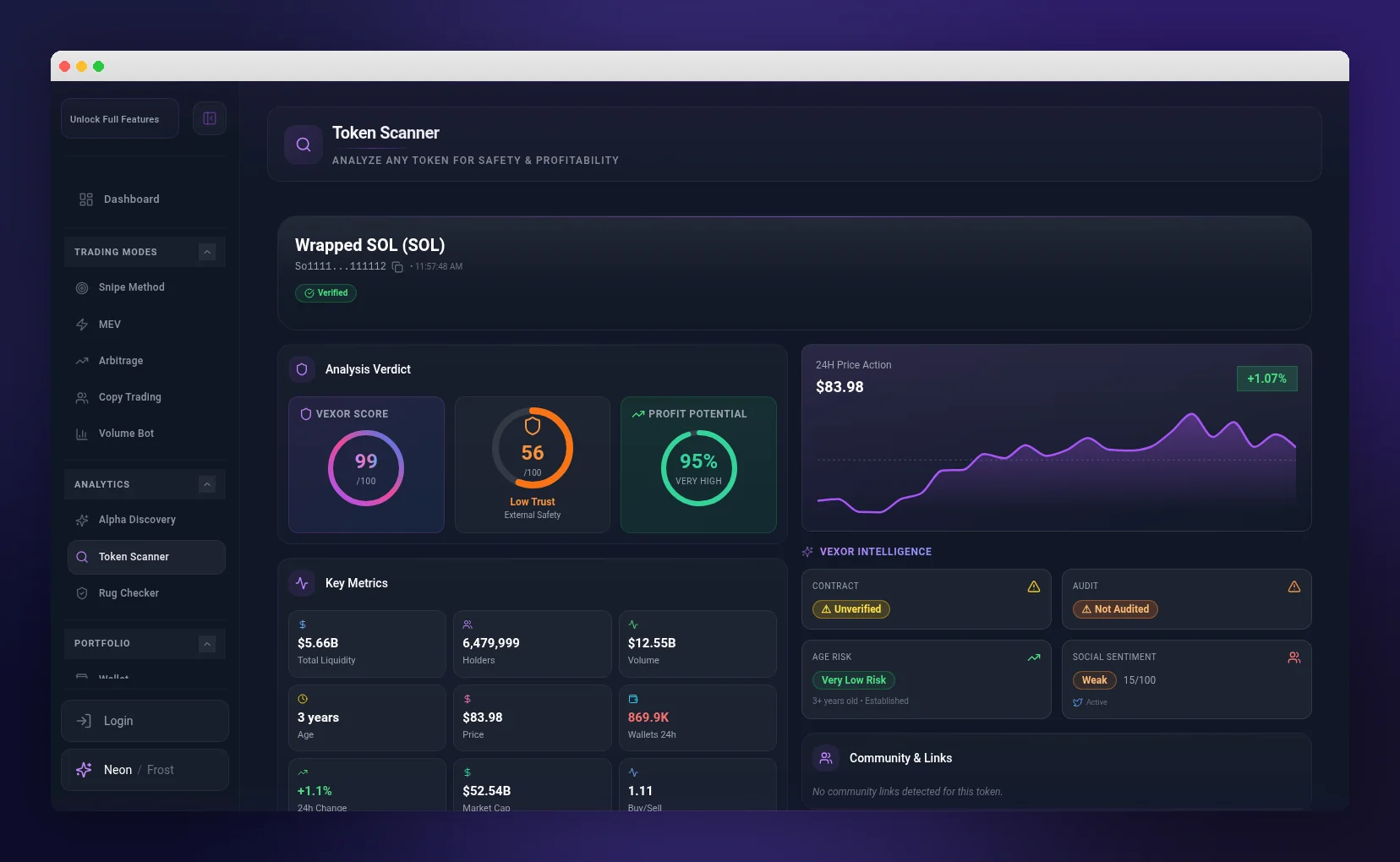
What the scanner enforces that a manual review usually misses:
- Auto-expansion of threats. If a serious risk flag fires (honeypot pattern, hostile deployer, unlocked LP, freeze authority still active), the security panel auto-expands so the threat is impossible to scroll past — the user can't accidentally ignore it.
- Serial-rugger detection. Vexor AI integration cross-references the deployer wallet against known repeat-rugger sets. A clean contract from a serial-rugger wallet is still rejected.
- LP lock and burn verification. EVM and Solana LP status are checked through different code paths (LP token burn for Solana, lock-contract introspection for EVM) but normalized into the same Trust Score input.
- Same engine, same verdict everywhere. The Snipe Engine, the Token Scanner, and the Telegram bot all consume the same scoring pipeline, so a token that's blocked in one surface is blocked everywhere — there is no "bypass via the bot" path.
This is what "AI-powered risk scoring" actually looks like in production: one number, one verdict, enforced server-side, with the raw signals available if you want to drill in.
Understanding Rug Pulls and Honeypot Tokens
Rug pulls occur when developers drain liquidity from a token, leaving holders with worthless assets. Rug pulls and honeypot scams have caused substantial losses across DeFi, making security features essential for any sniper bot crypto operation. These scams have become increasingly sophisticated, with attackers using complex smart contract mechanisms to hide their malicious intent until the moment they execute the exit.
Honeypot tokens are another insidious threat facing mev bot crypto traders. These tokens allow purchases but prevent sales through hidden code restrictions. Unsuspecting traders buy tokens that appear legitimate, only to discover they cannot sell or transfer their holdings. The contract code contains invisible restrictions that only activate during sell transactions.
Common honeypot mechanisms include excessive sell taxes (up to 99%), blacklist functions that block specific wallets, or transfer restrictions that prevent trading on decentralized exchanges. Advanced honeypots may even allow a few successful sells to create false confidence before blocking all subsequent transactions. Understanding these patterns is critical for protecting your ai sniper bot investments.
Smart Contract Red Flags Detection
Effective protection begins with thorough smart contract analysis before any trading bot crypto execution. Modern security systems scan for specific patterns that indicate potential scams or vulnerabilities. The most critical red flags include unlimited mint functions that allow developers to create tokens at will, significantly diluting existing holders.
Ownership concentration represents another major warning sign. When a single wallet controls more than 5% of the total supply, or the top 10 wallets control more than 50%, the risk of coordinated dumping increases exponentially. Automated systems must check ownership distribution across all wallets, including those involved in initial liquidity provision.
Liquidity lock status is perhaps the most important security indicator. Legitimate projects lock liquidity for extended periods using verified lock services like Unicrypt or Team Finance. Unlocked liquidity means developers can remove it at any moment, executing a rug pull. Your automatic crypto sniper bot should verify lock status and duration before considering any trades.
Hidden tax functions pose a significant threat to profitability. Some contracts implement dynamic taxes that change based on market conditions or wallet addresses. A token might appear to have a 2% tax during testing but implement a 50% tax for most buyers. Comprehensive testing across multiple scenarios is essential for uncovering these hidden mechanisms.
Smart contract verification on platforms like Etherscan or BSCScan provides transparency into contract code. Unverified contracts should be treated with extreme caution, as developers may be hiding malicious code. Advanced security systems automatically reject trades on unverified contracts unless explicitly overridden by the trader.
Advanced Honeypot Detection Techniques
Pre-transaction testing is the most effective defense against honeypot tokens. Before committing real capital, sniper bot crypto systems should simulate sell transactions using the same amount intended for the actual trade. This simulation reveals any restrictions or excessive taxes that would prevent profitable exits.
Gas estimation provides crucial insights into transaction viability. Honeypot contracts often require impossibly high gas limits for sell transactions, making them economically unviable. By analyzing the estimated gas cost for both buy and sell operations, automated systems can identify tokens that allow purchases but make selling impractical.
Buy and sell tax analysis must account for dynamic taxation schemes. Some contracts implement different tax rates based on transaction size, wallet balance, or time since purchase. Comprehensive testing should simulate various transaction amounts and timing to uncover these hidden mechanisms. The front run bot crypto infrastructure should perform these tests automatically.
Real-time honeypot detection APIs like Honeypot.is provide community-sourced information about known scam tokens. Integrating these services into your mev bot crypto system adds an additional layer of protection, leveraging collective intelligence to identify threats that individual analysis might miss.
Contract similarity detection uses machine learning to identify scam patterns based on code structure. Many honeypot contracts share similar code patterns or are clones of known scams with minor modifications. By maintaining a database of known malicious contracts and comparing new tokens against these patterns, AI systems can flag suspicious tokens before any capital is risked.
Wallet Security for Automated Trading
Proper wallet architecture is fundamental to protecting ai sniper bot operations. Never use a single wallet for both trading and storing significant capital. Trading wallets should contain only enough funds for immediate operations, with profits regularly transferred to secure cold storage.
Hot wallet best practices include using dedicated wallets for each blockchain to minimize cross-chain risk exposure. If one wallet is compromised, losses remain contained to that specific chain and balance. Implement automatic profit extraction that moves successful trades to secure wallets within minutes of execution.
Multi-signature setups provide additional security for larger operations. While single wallets are convenient for rapid sniping bot crypto execution, multi-sig wallets prevent unauthorized withdrawals even if one private key is compromised. Consider using multi-sig for profit storage while maintaining hot wallets for active trading.
Hardware wallet integration for cold storage ensures that accumulated profits remain secure even if computer systems are compromised. Popular options like Ledger or Trezor provide physical security for private keys while still allowing convenient access when needed. Never store hardware wallet seed phrases digitally or in cloud storage.
Private key management requires rigorous discipline. Never share private keys through email, messaging apps, or any digital communication channel. Use password managers like 1Password or Bitwarden with strong master passwords and two-factor authentication. Consider using separate devices for trading operations and cold storage management.
AI-Powered Risk Scoring Systems
Modern ai sniper bot platforms implement comprehensive risk scoring that evaluates multiple factors simultaneously. These systems assign numerical risk scores to potential trades based on contract analysis, market conditions, social sentiment, and historical patterns. Tokens scoring above certain thresholds are automatically rejected or flagged for manual review.
Social sentiment analysis monitors Twitter, Telegram, Discord, and Reddit for discussions about new tokens. AI systems analyze post frequency, user engagement, and sentiment to identify artificial hype campaigns. Genuine community interest follows distinct patterns that differ from coordinated pump-and-dump schemes.
Developer wallet tracking reveals the true intentions behind new tokens. By monitoring wallets associated with contract deployment and liquidity provision, security systems can identify developers with histories of creating scam projects. Many scammers use the same wallets repeatedly, making this tracking highly effective for fraud prevention.
Liquidity depth monitoring tracks how liquidity changes over time. Legitimate projects typically see growing liquidity as the community gains confidence. Declining liquidity often signals impending rug pulls, triggering automatic exits before developers drain remaining funds. Real-time monitoring enables trading bot crypto systems to react within seconds of suspicious activity.
Contract similarity detection uses pattern recognition to identify tokens that share code structures with known scams. Machine learning models analyze thousands of verified scam contracts, learning to recognize common patterns and variations. When new tokens match these patterns, they receive elevated risk scores or automatic rejection.
For more comprehensive security guidance, reference CoinDesk's DeFi security guide which provides additional context on protecting cryptocurrency investments.
Implementing Comprehensive Security Protocols
Successful sniper bot crypto operations require layered security approaches that combine multiple protection mechanisms. No single defense is perfect, but together they create robust protection against most threats. Start with automated smart contract analysis, then add real-time monitoring, social sentiment analysis, and manual review for high-value opportunities.
Configure your mev bot crypto system with conservative default settings that prioritize capital preservation over maximum profits. It's better to miss a few legitimate opportunities than to lose capital to scams. As you gain experience and refine your security protocols, you can gradually adjust risk tolerance based on documented case studies and real-time telemetry.
Regular security audits of your automated systems ensure that protection mechanisms remain effective as scammers develop new techniques. Review rejected trades weekly to verify your ai sniper bot isn't missing legitimate opportunities due to overly conservative settings. Balance security with profitability through continuous optimization.
By implementing these comprehensive security measures, your automated trading operations can operate with confidence across multiple blockchains. The combination of smart contract analysis, honeypot detection, proper wallet architecture, and AI-powered risk scoring creates multiple layers of protection that work together to keep your capital safe.
See how Vexor applies token scanning to sniping: Solana sniper bot.