Frontrunning Protection in 2026: Private Relays, Slippage Math, and Sniper-Grade Defense
Frontrunning is no longer a niche Ethereum problem. In 2026, sandwich bots run on Solana through Jito bundles, on every major EVM L2, and across cross-chain routers — and they extract value from anyone who submits a naked DEX swap to the public mempool. This guide is not a generic "watch your slippage" post. It explains exactly how the attack pipeline looks today, the slippage math attackers rely on, and how the Vexor Snipe Engine is built to refuse trades that would lose to it.
How a 2026 sandwich attack actually works
A modern sandwich attacker runs three things in parallel: a mempool / Jito ShredStream listener, a simulator that re-prices your swap against current pool reserves, and a bundle submitter that pays the validator/builder to land `buy → your swap → sell` in the same block. Their profit is, roughly:
`profit ≈ your_trade_size × (slippage_tolerance − natural_price_impact) − their_gas − builder_tip`
Three practical consequences fall out of that formula:
- If your slippage tolerance is set close to the natural price impact of the trade, sandwiching is unprofitable and the attacker skips you.
- If you set a flat 10–15% slippage on a low-liquidity pair (a common mistake on memecoins), you are funding the attacker's bundle.
- On Solana, the attacker pays the validator directly via Jito tips, so "high gas" doesn't protect you the way it used to on Ethereum.
Private relays: what actually protects you
Private transaction submission is the single biggest defense, but only if it's used correctly:
- Ethereum / EVM L2s: Flashbots Protect, MEV Blocker, and bloXroute route your transaction to block builders without exposing it in the public mempool. Your trade is invisible to sandwich bots until it's already in a block.
- Solana: Jito bundles let you submit your swap together with a tip, with the explicit guarantee that no other transaction is inserted between your instructions in that bundle. This is the Solana equivalent of a private relay.
- Fallback execution: Any production-grade system needs a public-mempool fallback for when private relays are degraded — otherwise you trade reliability for protection and end up with stuck transactions.
A private relay alone is not enough. It hides the transaction, but it does not stop you from setting bad slippage or trading into a honeypot. That's why the Vexor Snipe Engine treats private routing as one layer of a stack, not the whole answer.
How the Vexor Snipe Engine defends against frontrunning
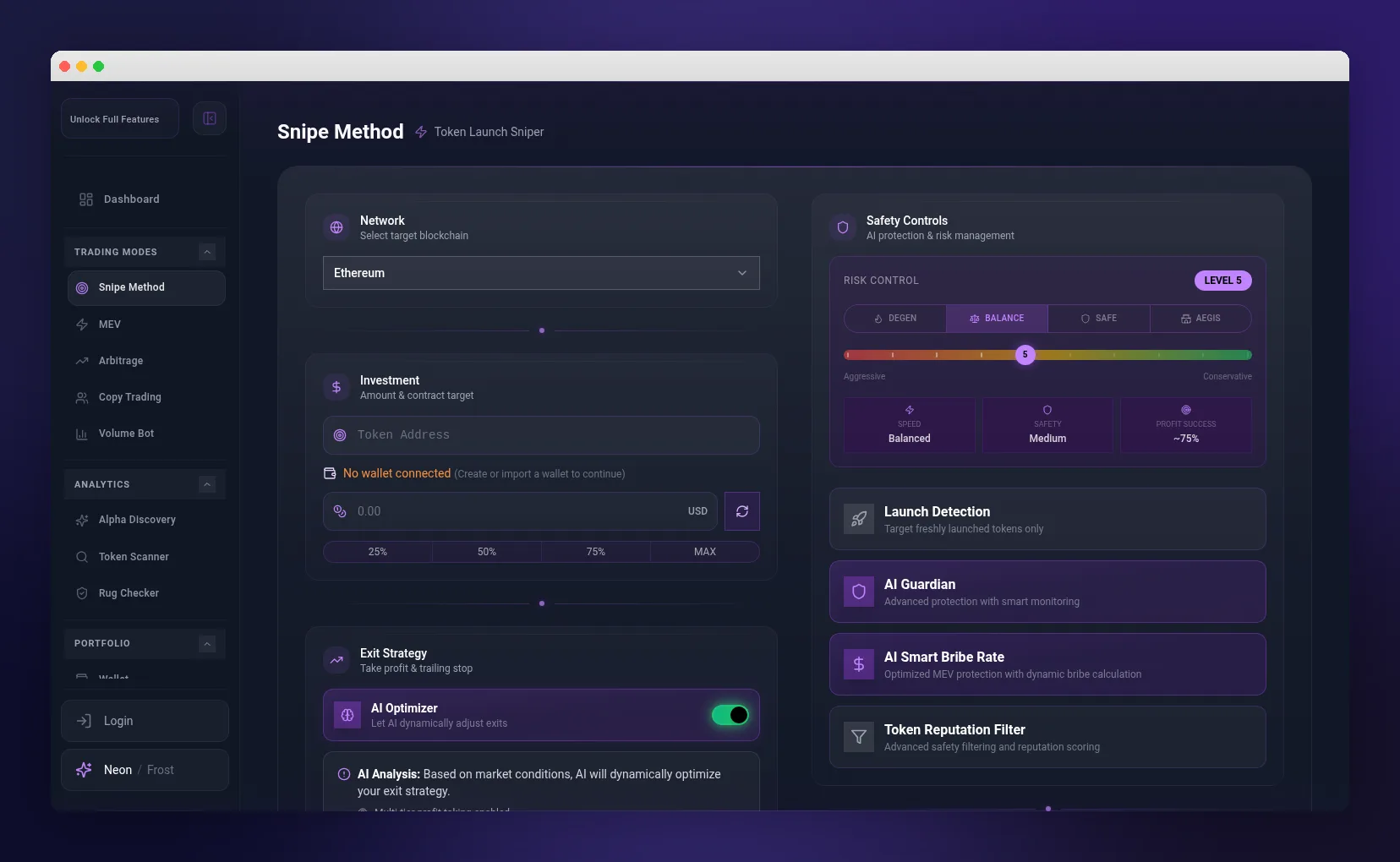
Vexor's Snipe Method was built around the assumption that the mempool is hostile. Every snipe goes through a server-authoritative pipeline before any capital moves, and the same Safety Score, Execution Grade, and risk controls are exposed in the modal so you can see the defense as it runs.
Key defenses built into the Snipe modal:
- Safety Score (1–10) gating. Every target token is scored by the Vexor AI Risk Engine before execution. Tokens scoring in the high-risk tier are rejected outright; mid-tier tokens force tighter slippage and smaller position sizing. This kills most rug / honeypot setups that sandwich bots actively bait traders into.
- Liquidity-aware slippage. Slippage isn't a single number you type in. The engine reads current pool depth from Jupiter V6 (Solana) or the 0x Swap API (EVM via Alchemy) and refuses configurations where slippage materially exceeds natural price impact — the exact configuration sandwich bots need to be profitable.
- Server-side execution with deterministic replay. Trades are constructed and submitted server-side, not from the browser, so the keypair, RPC routing, and bundle submission live behind the `vx-core` gateway. The on-chain entry/exit are then replayed deterministically in the UI via a Brownian bridge so you can see the real fill, not a fake animation.
- Execution Grade (A+ to C). After every fill, Vexor scores how cleanly the trade landed (slippage realized vs. expected, time-to-fill, exit capture). A repeated drop in grade on the same chain is a leading indicator that a relay is degraded or a route is being targeted, and is your signal to switch routing — not to raise slippage.
Reading the Safety Score and Execution Grade in practice
The defenses above only matter if you can read what the engine is doing on a live trade. Two surfaces in the Vexor Snipe Method make that explicit.
The Safety Score (1–10) and its tiers. Every target token is scored before execution and the score is rendered in one of four visual tiers (high trust, moderate, low, critical). The tier is not cosmetic — it controls how the engine sizes the trade and how tightly it bounds slippage. A target that drops from the high-trust tier into moderate mid-session is a real signal: liquidity has thinned, holder concentration has shifted, or a serial-rugger flag has fired since the last scan, and the engine will respond by tightening its risk envelope rather than letting you push more capital in.
The Execution Grade after every fill. Once a snipe lands, the trade is graded on a curve from A+ down to C based on how cleanly it executed: realized slippage versus the volatility-implied budget, time-to-fill, and how well the exit captured the move. Repeated drops in grade on the same chain are the most reliable leading indicator that a route is being targeted by sandwich infrastructure — the trades are still landing, but the slippage you're paying has quietly drifted up. The correct response is to switch routing or pause that chain, not to widen slippage tolerance and hand the attacker a bigger meal.
Why this is server-authoritative. The Snipe Engine builds and submits trades through the `vx-core` gateway with Alchemy (EVM) or Jupiter V6 (Solana) routing. The keypair never touches the browser, slippage floors are enforced before signing, and the on-chain fill is replayed in the UI as a deterministic Brownian bridge over the 5-minute Snipe timeframe. That last detail matters: the chart you're watching is a faithful replay of what actually executed, so a fill that looks bad on the chart was bad on-chain — it's not a UI artifact you can ignore.
A worked example of the loop. A target scores 8/10 at scan time, the snipe runs at the engine's normal slippage budget, and the fill grades A. Five minutes later a second target on the same chain scores 6/10; the engine accepts the trade but with a tighter slippage band and smaller size. The fill grades B+. A third target scores 4/10 — the trade is rejected outright, no instruction is constructed. That sequence is how you stay protected in a hostile mempool: you don't decide trade-by-trade under time pressure; the engine does, and you read the grades afterward to decide whether the routing itself is still healthy.
A short checklist before any DeFi swap in 2026
- Submit through a private relay (Flashbots / MEV Blocker on EVM, Jito bundles on Solana).
- Set slippage based on measured pool depth, not a fixed percentage.
- Reject trades on tokens that fail an automated safety scan — sandwich bots concentrate around honeypots and freshly deployed memecoins for a reason.
- Track realized vs. expected slippage. If the gap widens, your route is being attacked, not your settings.
- For active sniping, use a system like the Vexor Snipe Method where these defenses are enforced server-side instead of relying on you to remember them under time pressure.
For the deeper risk-engine and safety-score logic, see the Vexor FAQ and the Token Scanner used to vet targets before any snipe is allowed to run.
Frontrunning protection in 2026 is no longer about turning on one setting. It's a stack: private routing, honest slippage math, pre-trade safety scoring, and server-authoritative execution. Get all four right and sandwich bots route around you to find easier prey.