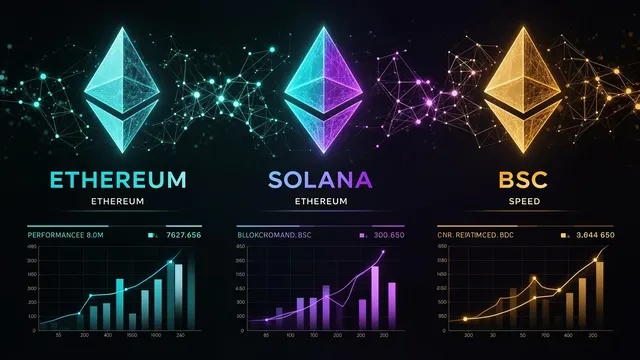
The evolution of decentralized finance across multiple blockchains has created unprecedented opportunities for sophisticated traders. While single-chain mev bot crypto strategies can be profitable, multi-chain operations unlock significantly greater potential by capitalizing on opportunities across Ethereum, Solana, BSC, and other networks. This comprehensive analysis compares these major chains and reveals how to optimize your sniper bot crypto performance across all of them.
Understanding Multi-Chain MEV Opportunities
The fragmentation of liquidity across multiple blockchains creates pricing inefficiencies that smart trading bot crypto systems can exploit. A token might trade at different prices on Ethereum, BSC, and Solana simultaneously, creating arbitrage windows that last only seconds. These opportunities arise from network-specific trading volumes, different market makers, and varying levels of bot competition on each chain.
Each blockchain ecosystem has developed its own MEV infrastructure and competitive landscape. Ethereum pioneered MEV extraction with Flashbots, Solana introduced Jito bundles for high-frequency operations, and BSC maintains a middle ground with moderate fees and high retail participation. Understanding these differences is crucial for optimizing mev bot crypto strategies across chains.
Multi-chain operations provide natural risk diversification. When Ethereum gas fees spike during network congestion, opportunities shift to Solana or BSC. By maintaining active sniper bot ethereum and sniper bot solana systems simultaneously, traders can capture profits regardless of which chain is most favorable at any given moment.
The technical complexity of multi-chain operations is offset by the significant competitive advantages they provide. Most retail traders and even many automated systems focus on a single chain, leaving cross-chain opportunities under-exploited. This reduced competition translates directly into higher success rates and better profit margins for those equipped to operate across multiple networks.
Ethereum: The Deep Liquidity Champion
Ethereum remains the dominant chain for DeFi with over $50 billion in total value locked, providing unmatched liquidity depth for mev bot ethereum operations. This deep liquidity enables larger trade sizes without significant slippage, making Ethereum ideal for high-capital strategies. The network's established infrastructure and extensive developer community ensure continuous innovation in MEV extraction techniques.
Flashbots integration represents Ethereum's most powerful MEV infrastructure. This system allows front run bot crypto operations to submit transaction bundles directly to miners, guaranteeing execution order and preventing front-running by competing bots. Bundles that fail don't pay gas fees, making Flashbots ideal for competitive opportunities where success rates might be below 100%.
However, Ethereum's success comes with significant costs. Gas fees during network congestion can exceed $100 per transaction, making many small-to-medium opportunities unprofitable. Peak congestion during major token launches or market volatility can push fees even higher, requiring careful opportunity evaluation before execution.
The network's 12-second block time creates a predictable rhythm for mev bot crypto operations. Traders can monitor the mempool between blocks and prepare transactions for optimal inclusion in the next block. This predictability, combined with sophisticated mempool monitoring tools, enables highly competitive strategies that are impossible on faster chains with less visible transaction pools.
Ethereum's established DeFi ecosystem provides the greatest variety of opportunities. From DEX arbitrage on Uniswap and Curve to liquidations on Aave and Compound, the diversity of protocols creates multiple profit vectors for sophisticated ai sniper bot systems. The network effects of having the most developers and users ensure continuous new opportunities as protocols launch and evolve.
For technical documentation on Ethereum MEV infrastructure, review Flashbots documentation which provides comprehensive guides for implementing bundle strategies.
Solana: The Speed and Scale Leader
Solana's 400-millisecond block time and sub-cent transaction fees create a fundamentally different mev bot solana environment compared to Ethereum. The network can process over 2,000 transactions per second, enabling high-frequency trading strategies that would be economically impossible on slower, more expensive chains. This speed advantage makes Solana ideal for opportunities requiring rapid successive transactions.
Jito bundles bring Flashbots-style MEV extraction to Solana, allowing sniper bot solana systems to submit transaction groups with guaranteed ordering. While Solana's mempool is less accessible than Ethereum's, Jito provides the infrastructure needed for competitive MEV extraction. The combination of fast blocks and bundle support makes Solana exceptionally powerful for certain strategy types.
However, Solana's speed creates intense competition. The low transaction costs enable more traders to operate profitably, increasing the number of bots competing for each opportunity. Success on Solana requires extremely low latency infrastructure, often measured in single-digit milliseconds. Half-second delays that would be acceptable on Ethereum can mean missing opportunities entirely on Solana.
The network's history of stability issues must be factored into trading bot crypto strategies. While Solana has significantly improved reliability since 2023, occasional performance degradation can still occur during extreme network load. Multi-chain systems should be prepared to shift focus to other chains when Solana experiences congestion or reduced performance.
Solana's growing DeFi ecosystem, particularly on Raydium and Orca DEXs, provides increasing opportunities for mev bot crypto operations. The network has become especially popular for meme coin launches and high-volatility trading, creating numerous sniper opportunities for well-positioned bots. The combination of low fees and fast transactions makes Solana ideal for strategies requiring many small transactions.
BSC: The Balanced Middle Ground
Binance Smart Chain offers an optimal balance between Ethereum's liquidity and Solana's speed. With 3-second block times and transaction fees typically under $0.50, BSC enables profitable sniper bot crypto operations at lower capital requirements than Ethereum while avoiding the extreme competition of Solana. This balance makes BSC an excellent starting point for traders building multi-chain capabilities.
PancakeSwap dominates BSC's DeFi landscape, concentrating liquidity and creating consistent arbitrage opportunities. The exchange's high retail participation and frequent new token launches provide numerous sniper opportunities for ai sniper bot systems. Unlike Ethereum's institutional-heavy market, BSC maintains strong retail engagement that creates exploitable inefficiencies.
BSC's EVM compatibility allows mev bot crypto systems developed for Ethereum to be adapted for BSC with minimal modifications. Smart contracts deploy identically, and familiar tools like Web3.js or ethers.js work seamlessly. This compatibility significantly reduces development time for multi-chain expansion compared to adding non-EVM chains like Solana.
However, BSC's centralization represents a trade-off for its performance and cost advantages. The network relies on 21 validators rather than Ethereum's thousands or Solana's hundreds, creating different trust assumptions. For trading bot crypto operations, this centralization rarely impacts functionality but should be considered when allocating capital across chains.
Gas optimization on BSC differs from Ethereum due to lower base costs but similar gas limit structures. Transactions that would be marginally profitable on Ethereum become solidly profitable on BSC due to the fee differential. This enables front run bot crypto strategies to target smaller opportunities that would be filtered out on more expensive chains.
Cross-Chain Arbitrage Mechanics
True cross-chain arbitrage involves identifying price discrepancies for the same token across different blockchains and executing simultaneous or near-simultaneous trades to capture the differential. A token might trade at $1.00 on Ethereum and $1.02 on BSC, creating a 2% arbitrage opportunity for mev bot crypto systems capable of bridging assets between chains.
Bridge protocols like Wormhole, Stargate, and LayerZero enable cross-chain asset transfers, but introduce latency and cost considerations. Bridge transactions might take 5-15 minutes to complete, during which prices can move substantially. Successful cross-chain strategies must account for bridge fees, timing risks, and potential price changes during transit.
Most profitable "cross-chain" strategies actually involve holding balances on multiple chains and executing trades independently rather than bridging assets for each opportunity. Your sniper bot ethereum system buys on Ethereum while your sniper bot solana system simultaneously sells on Solana, capturing the price differential without bridge delays. This requires sufficient capital allocation to each chain to handle opportunities as they arise.
Statistical arbitrage across chains leverages predictable price relationships without requiring direct asset transfers. When major price movements occur on Ethereum, similar movements typically follow on BSC and Solana with slight delays. Advanced ai sniper bot systems can identify these patterns and position trades to profit from the propagation of price changes across chains.
Technical Infrastructure Requirements
Running successful multi-chain trading bot crypto operations requires robust infrastructure optimized for each network. RPC endpoint selection dramatically impacts performance, with latency differences of 50-100 milliseconds common between providers. Premium RPC services provide dedicated nodes with lower latency and higher reliability than public endpoints.
Each chain requires separate wallet management with security considerations specific to that ecosystem. Ethereum wallets need sufficient ETH for gas, Solana wallets require SOL, and BSC wallets need BNB. Automated systems must monitor balances across all chains and implement alerts when any wallet drops below operational thresholds. Capital allocation should reflect opportunity frequency on each chain.
Chain-specific gas optimization differs significantly across networks. Ethereum requires sophisticated gas price strategies using EIP-1559 priority fees, Solana needs compute unit optimization, and BSC uses simpler gas price multipliers. Your mev bot crypto system must implement optimization appropriate for each chain rather than using generic approaches.
Monitoring infrastructure must aggregate data from multiple chains simultaneously. Successful sniper bot crypto operations require real-time analysis of new blocks, mempool activity, and DEX events across Ethereum, Solana, BSC, and potentially additional chains. This creates substantial data processing requirements that may necessitate dedicated server infrastructure rather than running on personal computers.
Profit Optimization by Network
Optimal trade sizing varies dramatically across chains due to different fee structures. On Ethereum, the high fixed gas cost means trades below $1,000 are often unprofitable, pushing mev bot ethereum systems toward larger opportunities. Solana's minimal fees enable profitable trades starting at $50-100, allowing mev bot solana systems to target much smaller opportunities with comparable overall profitability through higher volume.
Gas-to-profit ratio calculations must account for success rates, not just potential profits. An Ethereum opportunity with $200 potential profit and $50 gas cost appears attractive, but if your success rate is only 30%, the expected value becomes negative. ai sniper bot systems must incorporate historical success rates by chain and opportunity type into profitability calculations.
Timing optimization differs across chains based on block production and competition levels. Ethereum's predictable 12-second blocks allow submission timing optimization, while Solana's 400ms blocks require always-ready systems that can execute within the current block. BSC's 3-second blocks split the difference, requiring fast but not extreme execution speeds.
Competition analysis must be chain-specific. A strategy that's highly competitive on Ethereum might have significantly less competition on BSC or vice versa. Success rates for identical opportunity types can vary 20-30% across chains purely due to different competitive landscapes. Track performance metrics separately for each chain to identify where your trading bot crypto systems have comparative advantages.
For comprehensive chain statistics and TVL comparisons, reference DeFiLlama which provides real-time data across all major blockchain networks.
Future of Multi-Chain Trading
Emerging Layer 2 solutions on Ethereum like Arbitrum, Optimism, and Base create additional opportunities for mev bot crypto operations. These networks combine Ethereum's security with dramatically lower fees, potentially offering the best of both worlds. As liquidity migrates to L2s, multi-chain strategies must expand to include these networks for maximum opportunity capture.
Improved bridge technology and cross-chain communication protocols will reduce friction in true cross-chain arbitrage. Projects like LayerZero and Axelar are building infrastructure that enables faster, cheaper cross-chain transfers. As these mature, front run bot crypto strategies that currently avoid bridging due to costs and delays may become more viable.
The proliferation of specialized blockchains for specific use cases creates ongoing expansion requirements for comprehensive sniper bot crypto systems. Gaming-focused chains, NFT-specific networks, and other specialized ecosystems each develop their own trading opportunities. Successful multi-chain operations must continuously evaluate new chains for inclusion based on opportunity frequency and profitability.
Success in multi-chain ai sniper bot trading requires continuous learning and adaptation as each network evolves its MEV infrastructure. The strategies that work today will need refinement as networks upgrade, new competitors enter the market, and DeFi protocols innovate. Maintain flexible systems that can quickly adapt to changing conditions across all chains you operate on.
By implementing comprehensive multi-chain strategies that leverage the unique advantages of Ethereum's liquidity, Solana's speed, and BSC's balance, your mev bot crypto operations can capture opportunities unavailable to single-chain systems. The investment in multi-chain infrastructure pays dividends through diversification, reduced competition on smaller chains, and the ability to operate regardless of which network is most favorable at any given moment.