Sniper Bot Entry Timing: ATR, Volume Profile, and Real Indicators That Matter
Most "technical indicators for crypto trading" articles list 20 indicators and never explain which ones matter for the only thing a sniper bot actually has to decide: when to fill, how much slippage to allow, and where to take profit. This guide is narrow on purpose. It covers the three indicators that materially change sniper bot performance — ATR, Volume Profile, and Relative Volume — and shows how they map onto the Vexor Snipe modal's advanced analytics over a 5-minute timeframe.
Why generic TA fails for sniping
A standard RSI / MACD setup is built for swing trades on liquid pairs over hours or days. A sniper trade lives for seconds to minutes, on pairs that may have existed for under an hour, with order books too thin for classical TA to be statistically meaningful. Three things matter instead:
- How volatile is the asset right now? (sets your slippage budget)
- Where is the real liquidity sitting? (sets your take-profit and stop)
- Is current volume meaningfully above baseline? (separates a real ignition from noise)
That maps cleanly to ATR, Volume Profile / POC, and Relative Volume. Everything else is decoration in this timeframe.
ATR: the only honest input to slippage
Average True Range (ATR) measures realized volatility over a window. For a sniper bot, ATR over the last N minutes is the right input to slippage tolerance — not a fixed percentage. Useful rules of thumb on a 5-minute timeframe:
- Slippage tolerance ≈ 1.5–2.5× the most recent 1-minute ATR, capped by the configured Snipe Method risk tier.
- If ATR collapses mid-trade (volatility dies), reduce position rather than holding for a target the chart no longer supports.
- If ATR spikes, the take-profit ladder should widen proportionally — capping at the original target leaves money on the table during a real breakout.
The Vexor Snipe Engine consumes the equivalent live volatility signal and uses it as an input to the Execution Grade after each fill — a trade that paid significantly more slippage than ATR justified gets a lower grade even if it was profitable.
Volume Profile and Point of Control: where to actually exit
Volume Profile shows how much volume traded at each price level over a window. The Point of Control (POC) is the single price with the highest volume. For sniping, POC matters because:
- A POC just above your entry is a magnet — price tends to revisit it. That's a high-probability take-profit.
- A POC just below your entry is a support level only if it formed on real volume, not on a single wash trade. Dev/whale wash volume creates fake POCs that fail the moment the next real seller arrives.
- Multiple POCs across different timeframes (1m / 5m / 15m) that line up at the same price level is the strongest exit signal you'll get on a short-timeframe trade.
For low-cap launches the order book is thin enough that POC analysis must be combined with holder distribution — a POC formed by 3 wallets is meaningless. This is why Vexor's Token Scanner exposes top-holder concentration alongside the volume picture.
Relative Volume (RVOL): the ignition filter
Relative Volume compares current volume to a baseline (e.g. last hour, last day). For sniping:
- RVOL > ~3× over a 1-minute window with rising holder count is a real ignition.
- RVOL > 3× with flat or declining holder count is wash volume — skip the trade.
- RVOL falling below 1× while you're in a position is your signal that the move is over, regardless of where price is.
RVOL is the single best filter against wasting fills on dead launches. The Vexor Snipe modal surfaces volume velocity directly so you don't have to compute it yourself.
How the Vexor Snipe modal exposes these signals
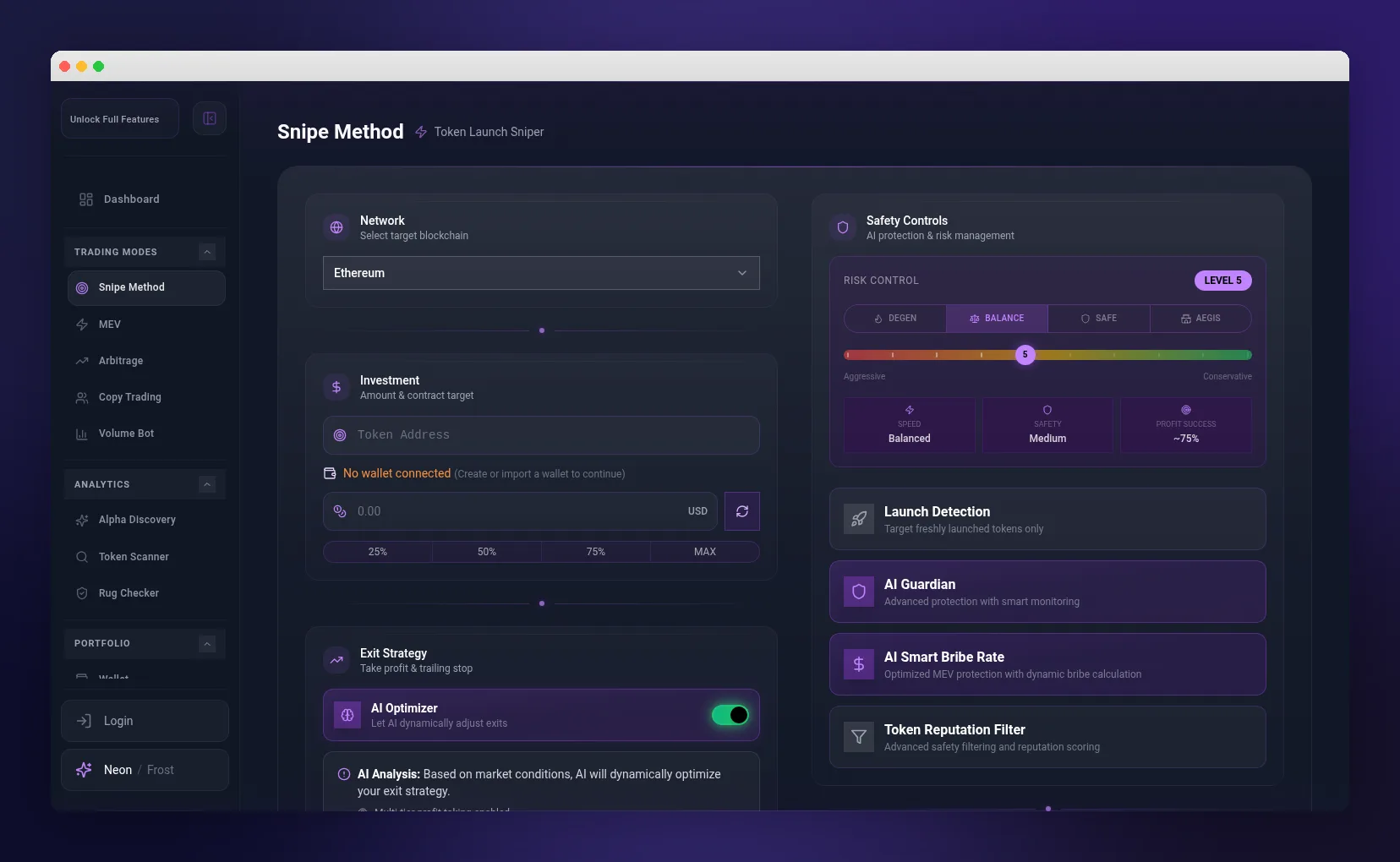
The Snipe Method runs on a 5-minute timeframe with a fixed set of advanced analytics rendered in real time as the trade plays out. The risk controls panel shows the current Safety Score, the Execution Grade target, and the slippage budget the engine is willing to use given live volatility — all derived from inputs equivalent to ATR, Volume Profile, and RVOL.
What the modal shows that a generic TA dashboard does not:
- Server-authoritative analytics. The metrics displayed are the same ones the Snipe Engine acted on, not a UI approximation. The Brownian-bridge replay of the on-chain fill makes the chart match the real trade.
- Execution Grade (A+ to C). A scoring layer over the trade that combines slippage paid vs. ATR, time-to-fill, and exit capture rate — i.e. the indicators above turned into a single number you can use to evaluate strategy quality across many trades.
- Pre-trade safety gating. Trades on tokens flagged by the Vexor AI Risk Engine are blocked regardless of how attractive the technical picture looks. Nothing destroys a sniper edge faster than perfect TA on a honeypot.
Wiring ATR, RVOL, and Volume Profile into the Snipe entry gate
Reading these indicators on a chart is one thing. Having them gate execution — so a bad volatility regime or a wash-volume signal actually prevents the trade — is what changes outcomes. Here is how the three signals map onto the live Snipe Method pipeline.
ATR → slippage budget, not a fixed percentage. The Snipe Engine treats the slippage you're willing to pay as a function of recent realized volatility, capped by the risk tier you've selected for the session. A high-volatility regime gets a wider budget so the trade actually fills; a quiet regime gets a tighter one so you don't overpay. After the fill, the Execution Grade compares realized slippage against the volatility-implied budget — a trade that paid materially more slippage than ATR justified gets a worse grade even when it ended green. Over many trades, that grade distribution is how you tell whether your route is healthy or whether you're quietly being targeted.
RVOL with holder-count cross-check → ignition filter. Volume by itself is easy to fake on a thin pair. A real ignition shows up as rising volume and rising distinct-holder count at the same time — fake ignition shows up as volume spiking while the holder count is flat or led by a handful of wallets. The Vexor discovery layer (Birdeye-backed, with on-chain backfill via Alchemy for Solana) surfaces holder distribution alongside the volume picture, so the Snipe modal can refuse a target whose volume is structurally unsupported by participation. This is the single highest-leverage filter for short-timeframe trading: most of the worst snipes come from buying wash-volume ignition.
Volume Profile and POC → exit placement, not entry conviction. A high-volume node above your entry is a magnet for the exit; a high-volume node formed by a small number of wallets is a trap. The Vexor Token Scanner exposes top-holder concentration directly, which is what lets you tell the difference. The Snipe modal's advanced analytics use the same data, so an exit ladder placed at a POC formed by three wallets gets flagged differently from one placed at a POC formed by hundreds of distinct participants.
The Safety Score override. None of the above runs if the Vexor AI Risk Engine assigns the target a Safety Score in the critical-risk tier. A token can have textbook-perfect ATR, RVOL, and Volume Profile and still be a honeypot or a serial-rugger deployment — the safety gate runs first and overrides the technical picture, because the most expensive way to learn this lesson is to take a perfect entry into a token you can't sell.
Why server-side enforcement matters. All four checks happen in the Snipe Engine before the buy instruction is constructed. A trader who tries to override them under time pressure can't — the floors and gates live behind the `vx-core` gateway, not in the browser. That's the point. Indicators that live next to a chart get ignored under stress; indicators wired into execution don't.
A minimal indicator stack for sniping in 2026
- ATR (1m / 5m) → slippage budget and take-profit width.
- Volume Profile + POC (1m / 5m / 15m alignment) → exit and stop placement.
- RVOL with holder-count cross-check → ignition filter / dead-trade exit.
- A pre-trade safety scan (Vexor Token Scanner) → kill the trade entirely if the token is hostile.
- Server-side execution with grading (Vexor Snipe Method) → so the indicators above are enforced, not just suggested.
For the full advanced analytics list and how Execution Grades are computed, see the Vexor FAQ.
Indicator inflation is the enemy of short-timeframe trading. Three honest signals — volatility, real liquidity, and ignition — beat ten lagging oscillators every time, especially when they're wired directly into execution rather than living on a separate chart you glance at after the trade is gone.